
It’s Real Food
The Delicacies of Fiction


By S. K. Ratidox
Did you know that I’m a writer? At least that’s what I claim and the amount of creative works and articulated musings I have filled my files with and uploaded to places like this would seem to constitute an accuracy to that tile. It is alluring to claim the prestige of being a writer because it carries some clout of artistic merit and status of intelligence when the lay public hears it. But I realize in my journey to be taken seriously as a writer, I can’t just shield myself with that title when I cannot repost with what I have created to impact my readers and convince them that. Yes indeed, this ambiguous oddball on the internet can craft a sentences that is both impactful and entertaining.
There is a fine line between quality writing and junk writing. I don’t want to use the polarizing terms of good or bad because there’s a lot of nuances when it comes to personal preference in the land of the written form of art. The line I speak of is subtle and to toe it takes mindful balance, especially on a rocky path ahead to get from ideas to completed works of writing that people can read and form opinions on. Am I being too meta while using this metaphor? Perhaps, but in the swamp of slop that permeates on the internet when it comes to the production of fiction or essays, it bears some consideration.
Let me address that new problematic stain in the online world that persists and spreads like mold. Artificial Intelligence. Good old large language models that we are all plagued with whether the public approves of them or not. With the advent of this software technology that can now spew out massive amounts of content with the press of an enter key following a simple prompt, it would seem that human writers are the John Henry of this modern railroad company.
But I have many doubts about the practicalities of this technology, and many share my skepticisms. It sucks to say that AI isn’t elevating humanity so much as rising the water level on our creative landscapes, turning lush wildernesses of meticulous wonder into a swamp of slop. I know that I may receive arguments from the cult of AI evangelists who will accuse me of ignorance about this technology, or that I’m not using AI the right way, or overlooking the beneficial utility of this technology. To which I say to these cultist:
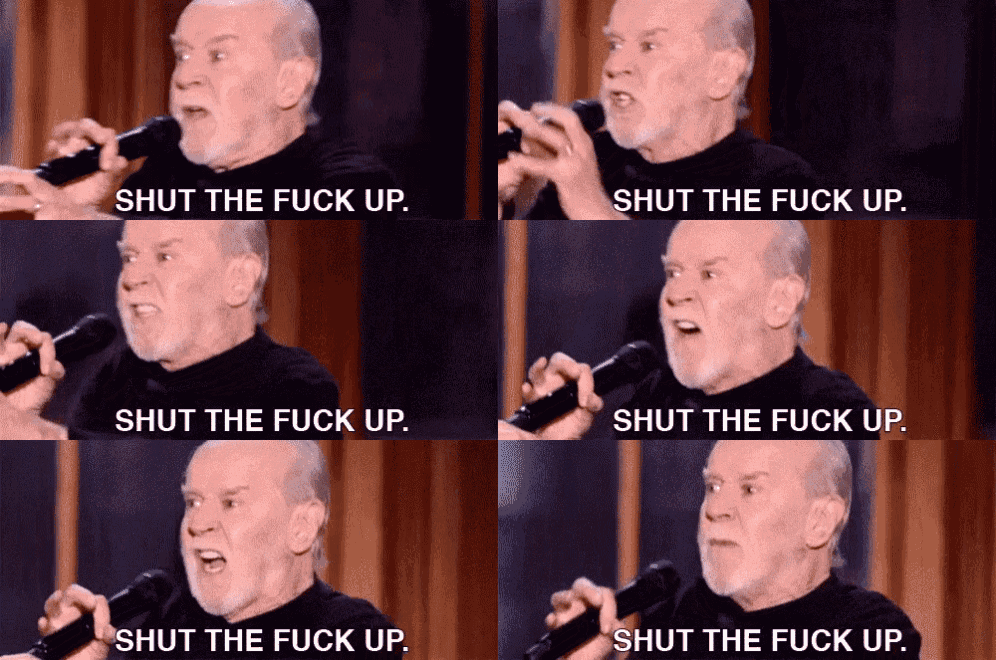
These chattering apes just took over where the cyrpo-grifters left off when their NFTs and Meme coins nosedived into the scam pit. I’m not one to buy into most sales pitches because when the calculator is on the desk and a contract appears, I smell a hustle and can’t believe that the shining veneer of the salesman really cares about me as a human being. Added to that is the economic displacement of AI in the workforce, choking out entry level workers or career employees that can’t keep up with technology or have too basic of job skills, so they are deemed expendable. While I may not lose sleep over technology finally riding people of bullshit jobs, I can’t enjoy seeing this new white-collar version of automation outpacing the factory workers. It’s just a sleeker and more fast paced exploitation of consumers at the expense of people who need to make a living.
I’ll put my deeper displeasures of AI to rest, but it has brought up a rather important, but daunting discussion in the world of artists and writers. You can no longer coast on mediocre content anymore. It’s a worry of mine that my writing is just mid-tier and will be given the rubber stamp of “good enough”, meaning not worth the time of the gatekeepers in the publishing industry. But with the advent of the self-publishing world, writers are free to churn out their content with full creative control. Huzzah! However, the drawback of that freedom came the influx of junk.
Allow me to strike up another metaphor for the state of writing as I see it. The truly creative works of writing are well crafted home meals, with the literary works considered akin to some expensive type of fine dining. Classics are old essential recipes that broke new ground in their day and gave inspiration for generations of new creations (some are bland, but others still carry that satisfaction of a well-made meal, or bank on nostalgia or romanticisms to overshadow their flaws).
Then the genre fictions are like ethnic food, where your tastes may vary and it’s okay if a dish is not enjoyable to you, but it still earns a following within its fan base (have you ever eaten Kimchi? Millions have and still enjoy it). The lazy writing that either gets published through some nepotistic tactics or dumped in some self-publishing feed is like hastily cooked meals, often made from a box or microwaved, yes it is a meal but you can tell there wasn’t much effort put into it, and it doesn’t stand out. Within the genre fiction is a different type of botched meal, akin to the culinary war crimes of Jamie Oliver attempting to make Asian cuisines with schizophrenic methods. Think of lazy genre writers as those ethnic fusion restaurants where there is a surface level representation of the culture and no one making the food has real ties to it.
Then the AI comes into play and instead of being a cooked meal, it’s processed junk food (think candy bars and bags of chips). Delicious and convenient, but everyone knows it has poor nutritional value. But much like many abundant comforts of our present world, whatever gives a short-term solution to an inconvenience is often adapted to before the long-term consequences are considered. Much like the spike in obesity since the advent of junk food, we are seeing a growing fungus of little to no creativity plague our resource of emotional and intellectual nutrition.
Putting aside the junk food of AI, I want to address the self-publishing people out there. Because you need to be better, especially now that the junk food/mold is spreading and won’t stop at the low hanging fruit of the world of fiction. Please let me come forward so you don’t consider this as a smug attack on your tactics of spreading your creations. You have ideas and ambition and are working to get your content out there. I respect you for that because I am one of you!
Hello, my name is S. K. Ratidox and I am a self-published author. I’ve been one for two years now and have no real success from my debut novel and don’t anticipate much more reception on my upcoming one. Given how limited my reading base is, you would think I am discouraged into rage-quitting this creative writing or in need of being on suicide watch. But I persist with writing my novels, my essays, and my short stories.
I may not be the work horse that Stephen King or Ray Bradbury described needing to be when gaining ground as a writer but they are dinosaurs immortalized in our museum of great writers, while the rest of us struggle to make a name for ourselves while the slop is rising around us. In this new swamp, we can’t be lazy with our writing. We cannot avoid criticisms or rely on the loyalty of fans that favor boxed Kraft Mac N Cheese over a classic Lasagna or an experimental meal made by a Michelin stared chef.
The challenging part of being a writer is that you have to develop that title through a body of work for people to read. You may be a talented individual when it comes to pitching a brilliant idea for a story, or configuring stunning prose, or creating characters that seem human so that any reader can empathize with them. But if you are keeping those talents locked away because you cannot face the possibility of someone not liking your work despite those skills, or encountering pushback from the editors and agents and publishing companies that want to negotiate the structure or themes of your book to give it more marketability, or you just don’t want to promote your work for the public to find it, then you aren’t an author but someone who writes. The difference is that you need some recognition from readers to call yourself an author. It’s a title that won’t mean anything if there is no proof, such as claiming to be a chef and yet you cannot cook a basic cheese omelet.
I never considered myself as an author until I finally took my final revision of my first novel and published it, perhaps I may not be worthy of that title as I have no readers of that novel nor any prospect that others will, but I made something and sent it out into the world. By most metrics of sales and readership, my novel Drop Dead Drunks is a failure, as of this writing. But that reality, despite being discouraging, hasn’t stopped me from writing. I have more stories I am working on and outside of the long form tales, I am drafting essays and short stories and reviews. Keeping the blade sharpened and my hands exercised in the skills I have developed. To consider myself a good writer is not my responsibility; that is for any readers of my work to deem, and I welcome it. Developing a skill becomes a more steady and refined process when feedback is given; especially from established, skilled peers.
Circling back to the main theme of this essay (I apologize for my tangents, but they bear some utility to my rants) about looking at the quality of fiction. I’ve been reading a fair amount of critiques and opinion pieces on the state of literary writing and the threat of LLMs becoming the assembly line to outpace the craftsmen. From what I’ve read and seen for myself, the AI tool will replace many...of the mediocre and lazy writers. Perhaps they may overshadow the good and great writers, the people who make significant works of art that deserve to be recognized and recorded into history. But when has a McDonalds or a Walmart been the nostalgic place of one’s childhood? Yes, people cling to the joys of their youth and if the fast food and big box stores were the only games in town, then they would hold an emotional memory to the giants of capitalism. Emotional connection is the root of power for brand loyalty that makes people irrationally faithful to a product or service that is just serviceable or convenient enough to claim superiority to the better-quality products.
AI is just the new smart phone or internet trend. There are useful aspects to it, but it will be cluttered with slop, on a different scale, and in a more problematic form. To combat AI in the world of art, I ask that you hold a few tactics that I maintain when it comes to navigating the swamp. Don’t go for the AI made posts/books, just don’t, because you might as well be eating candy and drinking soda for every meal when you read through something that was churned out through a few prompts and a massive waste of electrical and water-cooling resources. Call out people who use AI, not as a grand inquisitor calling for the offender to be burned at the stake, but to start an important dialogue about how AI would be better used in other aspects of life such as research or proofreading or coding software. Inform without lecturing, which is hypocritical of this essay, but I’m not coming into this claiming to have the answers. I’m promoting suggestions that people can refute if they have useful information I can learn from. Finally, give support beyond just a superficial “like” or a “restack” of someone’s work; comment on why you enjoyed it, or why you didn’t, ask questions, and spread the word if you think more people should read this. The more we engage with good writing from human authors, the more we will cultivate a community of quality.
We cannot get rid of AI; the genie is out of the bottle and it’s going full Robin Williams on our cultural and emotional landscape. It doesn’t have as much use to the art word as its creators will boast, because when all of us grew up under the science fiction of thinking machines it went either into the SKYNET, HAL 9000, or AM type of malevolent terror to mankind or it became more akin to a utopian tool that would elevate the quality of life for people. But instead of such ominous potential, we have a technology that can draft pages of content, edit it to be grammatically acceptable (in theory), and even design the artwork while the “creator” doesn’t have to do much more that promote it and take in the benefits (if they really get them).
The problem is that AI promotes the slovenly behaviors that won’t go away because people enjoy the path of least resistance, especially when our minds and bodies tend to feel overwhelmed in the influx of emotionally charged information in the real world. When people claim that everyone will just collectively get sick of AI, they seem to forget how insanely profitable McDonalds, Walmart, and Amazon are despite all of the horrific realities we learn about these companies at the cost of convenience. AI will just be a supercharged monstrosity much like the cordyceps of The Last of Us. AI is a contagion that can’t be thwarted, but if we intercept it with promoting a healthier community of human creation, we can endure the havoc of this living slop swamp.
Let me close this with a summation of my thoughts on writing. It is a skill and how you want that skill to develop and be utilized is your responsibility. We are all freelancers when it comes to being creative people; some of us rely on what we make to feed ourselves and live indoors, while others are on a side quest with our writing adventures. I’m not your parent and can’t stop you from using AI to modify or take over your writing, but I certainly can’t condone it nor support it. I will never pay for something that an AI made, but that may be a Sisyphean task as the gamblers of our economy keep dumping society’s dollars into the Church of AI. While that bubble keeps reaching the limits and will burst at some point in our world, don’t let your writing sink in quality, don’t get consumed or corrupted by the swamp of slop. You can’t compete or beat McDonalds, but you can craft a hamburger that makes everyone who eats it smile and appreciates your attention to detail, and that recipe will be more coveted than whatever is made in the filthy kitchen of the golden arches.